
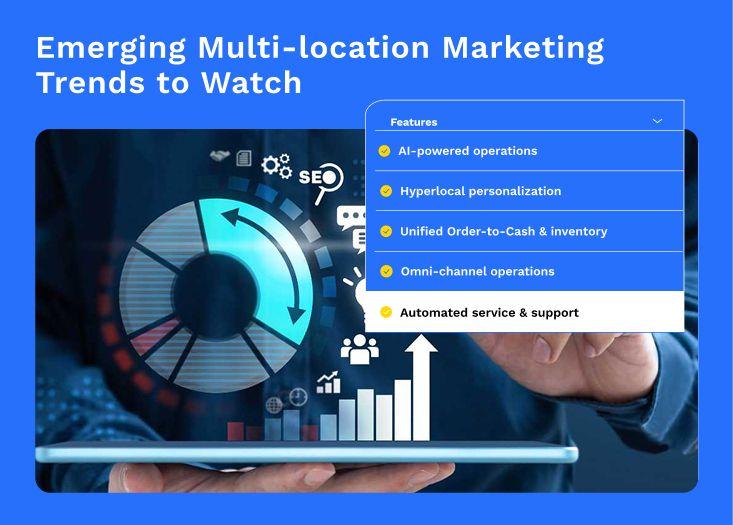
2026 is shaping up to be a transformative year for multi-location brands. With more than 70% of customer journeys beginning on local search and Google Maps, AI adoption, automation, and hyperlocal personalization are now essential for staying competitive across multiple locations.
Consumer behavior is evolving quickly as customers expect real-time search results, instant information, and seamless experiences before choosing where to visit or buy. Trust, accuracy, and local relevance now directly influence conversions, footfalls, and revenue. This makes it more important than ever for brands to invest in strong, consistent multi-location marketing.
2026 will also bring several surprising new trends that will redefine how businesses attract local customers and grow across different markets. In this blog, we explore the most important multi-location marketing trends that every brand must prepare for.
What Are Multi-location Marketing Trends?

Multi-location marketing trends refer to the evolving strategies, technologies, and consumer behaviors that influence how brands with multiple physical locations promote themselves, engage customers, and drive sales across different areas. Unlike single-location marketing, multi-location marketing focuses on optimizing performance for each location while maintaining overall brand consistency. By adopting the latest multi-location marketing trends, brands can enhance visibility, attract local customers, increase footfalls, and boost sales across all their locations.
Why Multi-location Marketing Trends Are Important
Multi-location marketing trends are essential for brands that want to remain competitive and relevant in today’s fast-changing market. Research shows that over 76% of local searches on Google result in a store visit within 24 hours, which means each location must be easily discoverable and optimized for local search. Customers increasingly expect personalized experiences, with 68% preferring brands that offer location-specific promotions, offers, and content. Ignoring these trends can lead to missed opportunities, lower footfalls, and reduced revenue, especially for businesses operating across multiple areas.
Moreover, each store or branch directly contributes to overall brand performance. With analytics and real-time reporting tools, brands can track location-wise engagement, leads, and sales to make data-driven decisions. Multi-location marketing trends enable businesses to maintain brand consistency while catering to local preferences, improving customer trust and loyalty. By adopting these strategies, brands can ensure every location maximizes visibility, delivers a superior experience, and drives measurable growth across all markets.
Top 10 Multi-location Marketing Trends for 2026
Before exploring the list, it is important to understand how multi-location marketing trends are reshaping the future of distributed retail networks. These trends are redefining how brands operate, acquire customers, and scale across regions.
#1 Multi-location Marketing Trend - Agentic AI Becomes the Core of Multi-location Operations

Agentic AI is becoming the most influential force behind multi-location success. In 2026, AI agents are not just assisting teams but autonomously executing tasks such as forecasting, pricing adjustments, onboarding, and localized marketing actions. This helps brands manage dozens or hundreds of locations with unmatched efficiency, making operations faster and significantly more reliable across every region.
Read Also - How Sekel Agentic AI Tool Keeps All Your Locations on Track
#2 Multi-location Marketing Trend - Hyperlocal Personalization at Scale

Customers are demanding deeply relevant experiences tied to their location. Brands are now using hyperlocal personalization to tailor content, offers, product visibility, and communication based on pin code behavior, store-level inventory, and cultural preferences. This creates higher engagement and conversion because every interaction feels more accurate and relatable to the customer’s daily environment.
#3 Multi-location Marketing Trend - Real-time Local Search Intelligence Shapes Discovery
More than 70 percent of purchase journeys begin on search, which makes real-time intelligence essential. Instead of relying on outdated SEO strategies, brands are reacting to live search trends, competitor availability, and hyperlocal intent signals. This helps multi-location businesses remain visible at the exact moment customers are looking for products and services across different locations.
#4 Multi-location Marketing Trend - Unified Multi-location Content Automation
Content automation is becoming a game-changer for brands managing multiple outlets. AI-powered content engines now generate localized blogs, store pages, descriptions, and social posts in seconds. This allows brands to maintain consistency while providing timely and personalized information for each location, significantly boosting SEO performance and customer engagement.
Read Also - How Dynamic Content Management Tool Drives Hyperlocal Sales
#5 Multi-location Marketing Trend - AI-powered Sales and Channel Management Systems

Multi-location sales operations are becoming smarter through AI-driven systems that unify dealer management, EPOS integration, eCommerce flow, warranty handling, claims, returns, and service management. This centralization reduces operational errors, improves service speed, and ensures seamless coordination between central and regional teams across the entire network.
Read Also - Why AI-Powered EPOS Is the Future of Hyperlocal Retailing
#6 Multi-location Marketing Trend - AI-powered Predictive Inventory Management

Managing inventory across multiple locations is becoming increasingly complex as customer demand fluctuates rapidly. In 2026, predictive inventory management powered by AI helps brands forecast demand accurately for each store, optimize stock levels, and prevent both overstocking and stockouts. By analyzing historical sales, local trends, and real-time data, brands can ensure that the right products are available at the right place and time, improving sales, reducing costs, and enhancing the customer experience across all locations.
Read Also - Omnilocal Inventory Management Platform for Smarter Retail
#7 Multi-location Marketing Trend - Intelligent Order Management Systems
Managing orders efficiently across multiple locations is critical for modern brands. Intelligent order management systems centralize order processing, track inventory in real time, and synchronize sales across stores, e-commerce, and distribution channels. By automating workflows for order validation, fulfillment, and returns, brands reduce errors, shorten delivery times, and provide a consistent experience across all locations.
#8 Multi-location Marketing Trend - Unified Omni-channel Operations

Customers expect seamless experiences across online and offline touchpoints. Multi-location brands are integrating all sales channels, including stores, marketplaces, and e-commerce platforms, to ensure synchronized inventory, pricing, and promotions. Unified omni-channel operations help brands respond to customer demand in real time, optimize stock allocation, and improve revenue while maintaining a consistent brand presence everywhere.
#9 Multi-location Marketing Trend - Automated Customer Experience and Service Management
Post-purchase service and customer experience are becoming key differentiators. Automated systems now handle warranty claims, service scheduling, returns, and customer communication with minimal manual intervention. By streamlining service workflows and providing real-time updates, brands enhance satisfaction, loyalty, and repeat business across all locations.
#10 Multi-location Marketing Trend - Integrated Hyperlocal Tech Stack Becomes Essential for Scale
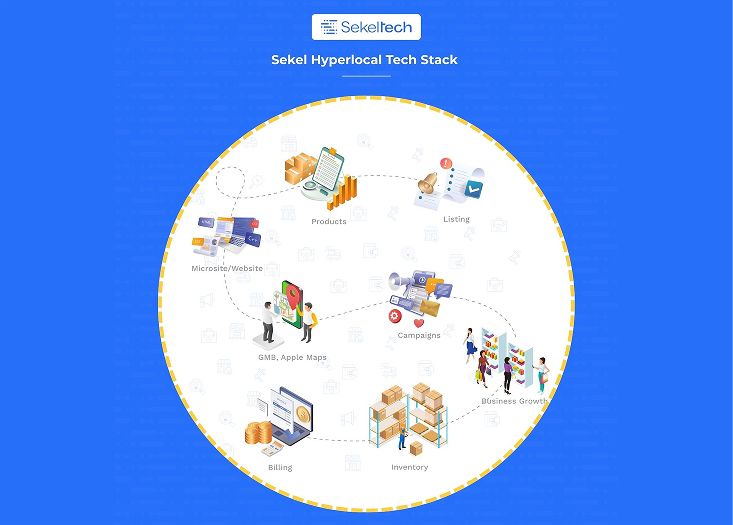
Multi-location brands cannot operate efficiently using disconnected tools. In 2026, a unified hyperlocal tech stack becomes essential. Platforms like Sekel Tech bring together discovery systems, store microsites, live inventory, agentic AI forecasting, Google Business Profile optimization, territory heatmaps, and attribution reporting. By replacing guesswork with real-time intelligence, Sekel Tech helps brands scale faster, enter Tier 2 and Tier 3 markets confidently, and operate more profitably.
These multi-location marketing trends highlight how quickly consumer expectations and operational challenges are evolving. Brands that adapt early gain a competitive edge, streamline operations, and build deeper customer trust across every store.
Read Also - 10 Multi-Location Marketing Strategies for Brands in 2025
How These Multi-location Marketing Trends Influence 2026 and Beyond
The influence of these multi-location marketing trends stretches well beyond 2026, fundamentally reshaping how modern brands operate, compete, and scale. As customer expectations accelerate and digital behavior becomes more real-time, brands cannot depend on outdated, manual, or disconnected systems. Those that adopt AI-driven operations, automation, hyperlocal personalization, and unified technology platforms will gain a measurable advantage in visibility, customer trust, and operational efficiency across every location.
These multi-location marketing trends are also laying the foundation for long-term growth. Businesses that embrace them early will strengthen their local presence, improve discovery, and deliver seamless customer experiences across all stores. With rapid expansion in Tier 2 and Tier 3 markets, these trends will ultimately determine which brands lead the next phase of multi-location retail. The companies that act now will be the ones best positioned to dominate future hyperlocal markets and sustain growth in the years ahead.
Read Also - Top Multi-Location Marketing Companies with Generative AI
Benefits of Following These Multi-location Marketing Trends
Benefit | Impact on Multi-location Brands |
Higher Local Visibility | Better ranking on Google and Maps, improved local discovery. |
Stronger Customer Engagement | More relevant, location-specific experiences that boost conversions. |
Operational Efficiency | AI and automation reduce manual work and speed up processes. |
Accurate Demand & Inventory | Real-time data prevents stockouts and overstocking. |
Consistent Brand Experience | Uniform service quality across all store locations. |
Fast, Data-backed Decisions | Central insights help teams act quickly and confidently. |
Increased Footfalls & Sales | Improved visibility and local marketing drive store visits. |
Higher Customer Loyalty | Seamless service journeys build long-term trust. |
Reduced Costs | Automation cuts manual errors and operational expenses. |
Future-ready Growth | Brands stay competitive and prepared for market shifts. |
Watch the video to see how Sekel Tech’s platform simplifies managing multiple stores, from listings to sales and reporting, all in one place.
Sekel Tech: Enabling Brands to Lead With Multi-location Marketing Trends
Sekel Tech empowers brands to adopt and fully leverage the latest multi-location marketing trends, helping them scale faster and operate smarter across every location. As India’s leading hyperlocal tech stack, Sekel Tech unifies discovery, operations, AI-driven forecasting, and customer engagement into one connected platform that delivers real-time accuracy and visibility across all stores.
At Sekel, our Hyperlocal Tech Stack powers true Omnilocal Commerce through three core engines:
1. Hyperlocal Discovery Engine: Boosts visibility and drives high-intent enquiries.
2. Order-to-Cash (O2C): Unified ordering, inventory sync, payments, and fulfillment across all channels in one closed loop.
3. Task Manager: Real-time task orchestration that ensures execution and eliminates gaps typical in multi-system retail operations.
In addition, Sekel Tech offers a comprehensive suite of features to manage every aspect of multi-location retail operations:
- Smart EPOS for seamless point-of-sale operations
- Content Management (CMS) for location-specific content updates
- Sekel Agentic AI for autonomous decision-making
- Customer Data Platform to unify customer information across stores
- Lead Management for tracking and converting enquiries
- Consent and Compliance Management to ensure regulatory adherence
- Order Management for omnichannel order fulfillment
- Warranty & Service Management to manage post-purchase services
- Sekel AI ChatBot for automated customer interactions
- Listing Management to maintain accurate store information
- Store Locator and Store Microsites for hyperlocal discovery
- Product Catalogue for centralized inventory display
- Review Management to monitor and respond to customer feedback
- STP Automation for Segmentation, Targeting, and Personalization
- Role-Based Access for secure operations
- Security & Compliance to protect data and transactions
- Real-Time Sales Conversion Analytics for actionable insights
This fully closed-loop, unified system delivers guaranteed success with higher conversions, zero leakage, and measurable ROI from day one. Sekel simplifies and accelerates your omnilocal growth, enabling brands to dominate Tier 2 and Tier 3 markets, streamline operations, and convert local discovery into real revenue.
Watch the video to see how Sekel Tech centralizes all store operations listings, content, reviews, and sales, making multi-location management effortless. "Manage Listings, Content, Reviews & Sales - All in One Place"
Frequently Asked Questions (FAQs)
1. What does multi-location marketing involve?
Multi-location marketing involves strategies and tools that help brands with multiple outlets reach customers, promote products, and manage operations effectively in each location while maintaining overall brand consistency.
2. Why should businesses focus on trends in multi-location marketing?
Focusing on these trends allows businesses to stay competitive, improve customer engagement, optimize operations, and increase sales across all store locations by leveraging AI, hyperlocal marketing, and automation.
3. How can technology improve performance across multiple locations?
Technology enables real-time inventory tracking, automated order management, predictive analytics, and customer insights. It helps brands respond faster to local demand and ensures smooth operations across all stores.
4. What impact does hyperlocal marketing have on local stores?
Hyperlocal marketing ensures each store reaches customers in its immediate area through targeted promotions, local search visibility, and personalized campaigns, which drives footfalls and higher conversion rates.
5. How can brands achieve measurable results from multi-location marketing?
By using integrated platforms and tech stacks, brands can track performance, automate workflows, and analyze data from each location. This ensures higher efficiency, reduced errors, increased conversions, and clear ROI.
Conclusion
In 2026, staying ahead of multi-location marketing trends is nolonger optional. It is essential for brands that want to grow, engage customers, and dominate local markets. By leveraging AI, hyperlocal personalization, real-time insights, and unified operations, multi-location businesses can maximize visibility, efficiency, and revenue across all stores. Sekel Tech empowers brands with a complete hyperlocal tech stack, enabling seamless execution, measurable ROI, and accelerated omnilocal growth. Start transforming your multi-location business today and turn local discovery into real revenue with Sekel Tech.