
Order-to-cash process is the business workflow covering order entry, fulfillment, invoicing, payment processing, accounts receivable, and collections. It connects every step from receiving and fulfilling customer orders to final cash application and reporting.
Most businesses obsess over getting the sale. Few obsess over what happens after it. That gap is where revenue leaks.
The order-to-cash process, also known as O2C or OTC, is the complete business workflow that starts the moment a customer places an order and ends when payment is received, reconciled, and reported. Every step in between, order entry, fulfillment, invoicing, payment processing, accounts receivable management, and cash application, directly affects how fast and accurately a business converts sales into actual cash.
When O2C runs smoothly, cash flow is predictable, customers are happy, and operations scale without friction. When it doesn't, invoices get delayed, payments get stuck, and reconciliation becomes a monthly nightmare.
For multi-location brands managing hundreds of orders daily across stores, warehouses, and distribution channels, a fragmented O2C process doesn't just slow things down. It actively costs revenue.
This guide covers what is order to cash process steps, common challenges, best practices, and how modern platforms are automating the entire cycle end to end.
What Is Order to Cash Process?
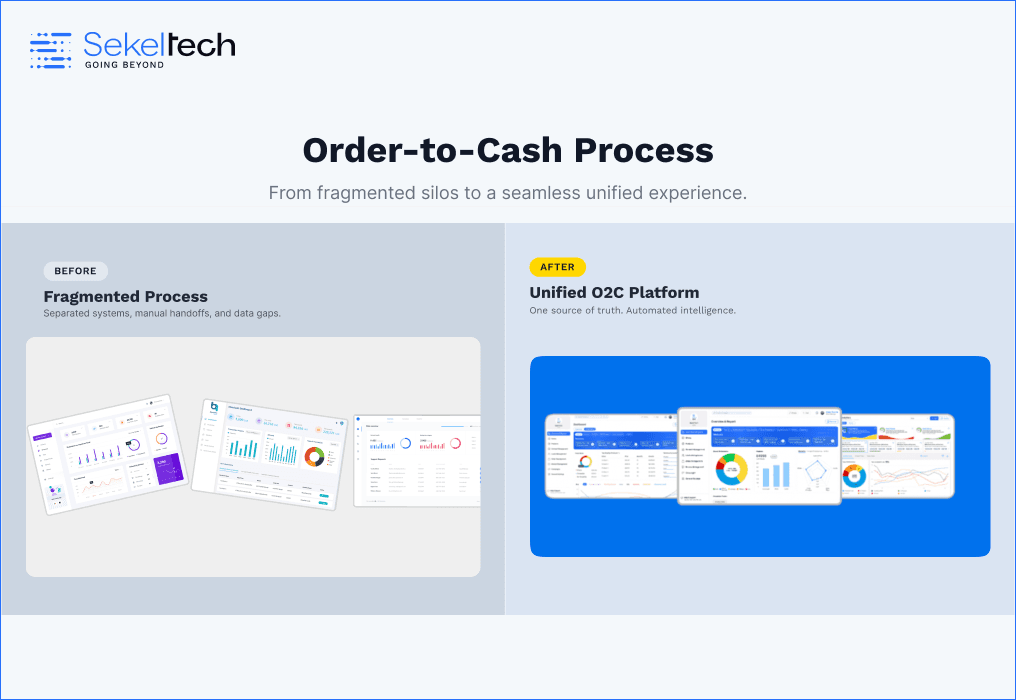
Order-to-cash (O2C or OTC) is the complete business process that starts when a customer places an order and ends when payment is successfully received and reconciled. It connects every revenue-generating function in one continuous workflow.
In simple terms, O2C is how a business receives, processes, fulfills, invoices, and gets paid for orders. Not just the transaction. The entire journey from order confirmation to cash in the bank.
A strong order-to-cash process matters because it directly impacts three things every business cares about. Cash flow, operational efficiency, and customer experience. When each step runs accurately and on time, revenue is predictable. When steps break down, the entire business feels it.
Order-to-cash goes far beyond finance. It touches inventory planning, logistics, customer communication, and reporting. Sales, operations, and finance teams all depend on it working correctly.
For growing businesses and multi-location brands, managing O2C manually or through disconnected tools becomes unsustainable fast. Orders flow from multiple channels. Inventory moves across locations. Payments come through different rails. Without a unified system connecting all of it, errors compound and revenue leaks quietly at every stage.
That is why modern businesses rely on integrated O2C platforms to automate the cycle, eliminate manual errors, and maintain real-time visibility from order entry to cash application.
Why Is Order-to-Cash Process Important?
The order-to-cash process is a defining part of how a business operates, and it plays a much bigger role in customer relationships than most companies realise. While many businesses focus the bulk of their energy on closing the sale, what happens after the order is placed is equally important. A well-optimised order to cash O2C process yields benefits that ripple across the entire organisation.
O2C affects every part of your business.
Order-to-cash activities touch operations across the organisation, including inventory management, supply chain, logistics, and finance. A bottleneck in invoicing creates cash flow problems. A delay in fulfillment damages customer trust. An error in accounts receivable affects payroll and supplier payments. These functions are deeply interconnected. Weakness in one area creates headaches in departments that seem completely unrelated.
It determines how cash flows into your business.
The invoicing and accounts receivable functions carried out during O2C directly control the company's cash inflows. Delays in collection complicate accounts payable, interrupt payroll cycles, and limit the ability to plan for growth. Businesses that collect faster simply have more options.
It reflects how well your entire operation runs.
Managing a reliable and consistent order to cash(O2C) process is not just a finance function. It requires every department to perform well. Sales, operations, logistics, and accounting all contribute to whether an order moves from placement to payment smoothly or gets stuck somewhere in between.
According to , companies that adopt best-in-class O2C practices are 81% more effective at order management than those relying on manual or fragmented processes.
Order-to-Cash Process Steps
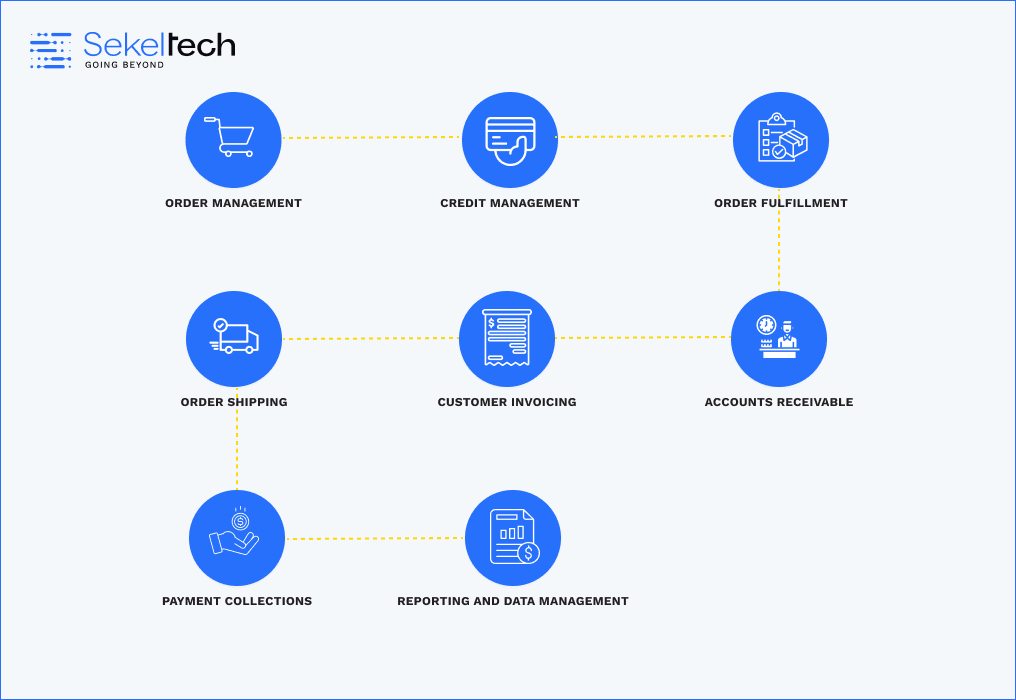
The order-to-cash process has eight steps. Each one connects to the next. A breakdown at any stage affects everything that follows.
Step 1: Order Management
The O2C process starts the moment a customer places an order. Through a store, a distributor, an app, or a sales rep. It doesn't matter how the order arrives. What matters is that it's captured accurately and instantly in a standardised digital format.
Paper orders and disconnected systems create errors that compound through every step downstream. Automated order management ensures the right teams are notified immediately and nothing falls through the gaps.
Step 2: Credit Management
For businesses extending credit, a check happens before the order moves forward. First-time customers go through an approval process. Returning customers with existing credit move straight to fulfillment. Those with previous denials start fresh.
Getting this right upfront makes accounts receivable significantly easier to manage later. It also protects cash flow by ensuring credit only goes to customers who can actually pay.
Step 3: Order Fulfillment
This is where the product starts moving. Inventory must be updated in real time so the system never accepts an order it can't complete. If an out-of-stock situation does slip through, it needs to be flagged immediately and the customer notified before billing happens.
For multi-location brands, fulfillment is where complexity multiplies. Orders might ship from a warehouse, a nearby store, or a distribution partner. Without real-time inventory visibility across all locations, fulfillment errors are a matter of when not if.
Read Also: Omnilocal Inventory Management Platform for Smarter Retail
Step 4: Order Shipping
Once fulfilled, the order moves to shipping. Logistics teams need accurate, real-time data from the fulfillment stage to plan around carrier schedules and hit delivery windows. A product that ships correctly but arrives late still damages the customer relationship.
For businesses running hyperlocal delivery or ship-from-store models, routing decisions need to happen automatically based on proximity, stock availability, and delivery timelines.
Step 5: Customer Invoicing
Invoicing is where many order-to-cash processes quietly fall apart. Delays and errors here directly delay payment collection and create disputes that can drag on for weeks.
Accurate invoices need to go out automatically using data from every upstream step. Order details, pricing, credit terms, shipping dates, and tax compliance, including GST for Indian businesses, all need to flow into the invoice without manual re-entry.
Read Also: Smart Billing System for Faster Retail Operations & Growth
Step 6: Accounts Receivable
Once invoices are sent, accounts receivable takes over. Outstanding invoices should be flagged automatically before they go overdue. When errors are found, teams need to trace the issue quickly, correct it, and reissue without delay.
Every day an incorrect invoice sits unresolved is another day payment gets pushed back. Visibility into which customers pay on time and which consistently delay helps finance teams forecast cash flow accurately.
Step 7: Payment Collections
Problems in payment collections usually start earlier in the process. Payments that have been made but not recorded create false outstanding balances. This frustrates customers and distorts cash flow forecasts at the same time.
When an invoice goes overdue, the account should be flagged automatically. For multi-location brands processing transactions across UPI, cards, COD, and wallets daily, automated payment reconciliation is the only practical way to manage collections at scale.
Step 8: Reporting and Data Management
Reporting is the step most businesses underinvest in. But it's the one that makes every other step improvable.
Which stage causes the most delays? Where do invoicing errors come from?
Which locations have the highest fulfillment error rates? These questions can only be answered with connected data flowing from every stage of the order to cash O2C cycle. Without it, problems stay hidden. With it, the order-to-cash process becomes a genuine source of business intelligence, not just an operational workflow.
Watch this quick video to see how Sekel Tech helps brands manage orders, listings, and sales all from one place.
O2C vs Traditional Order Management
As businesses scale across locations and channels, the gap between traditional order management and a full order-to-cash process becomes very clear. Traditional systems focus on capturing and processing orders. O2C manages the entire revenue lifecycle from order creation to final payment reconciliation.
Aspect | Traditional Order Management | Order-to-Cash Process |
Scope | Order creation and basic fulfillment | Complete cycle from order entry to cash application |
Automation | Largely manual with multiple handoffs | High automation with straight-through processing |
Payments and Reconciliation | Handled separately through finance tools | Fully integrated invoicing, payments, and reconciliation |
Visibility | Fragmented data across teams | Single dashboard with end-to-end visibility |
Credit Management | Manual approval process | Automated credit checks and approvals |
Reporting | Disconnected reports by department | Unified real-time reporting across all O2C stages |
Scalability | Struggles with high volumes and multiple locations | Built to scale across locations and channels |
Best For | Small, single-location businesses | Growing and multi-location brands |
Traditional order management supports individual transactions. An order-to-cash process supports business growth. By connecting sales, operations, and finance into one workflow, O2C reduces friction, improves cash flow control, and helps brands scale without operational chaos.
B2B vs B2C Order-to-Cash Process
The order-to-cash process works differently depending on who you're selling to. B2B cycles are longer, more complex, and relationship-driven. B2C cycles prioritise speed, accuracy, and zero friction at checkout.
Aspect | B2B | B2C |
Order Complexity | Large, bulk, and often customised orders | Smaller, standard, and simpler orders |
Credit Checks | Required before processing | Minimal, usually instant payment |
Payment Cycles | Longer terms, 30 to 90 days typical | Immediate, COD, cards, UPI |
Payment Type | Contract-based invoicing, bank transfers | Cards, wallets, UPI, cash |
Workflow | Multiple approvals, semi-automated | Mostly automated, minimal approvals |
Reconciliation | Complex, multi-party settlements | Simpler, faster reconciliation |
Customer Interaction | Dedicated account managers | Self-service, fast checkout |
In B2B, credit terms, contract pricing, and multi-party approvals add layers that don't exist in B2C. In B2C, customers expect instant confirmation, fast delivery, and accurate invoices every time.
For brands managing both models simultaneously, like selling directly to consumers while running a distributor and dealer network, a unified order-to-cash process that handles both in one system is not optional. It's essential.
Read Also: B2B B2C D2C Business Models: Difference with Examples
Order-to-Cash Process Best Practices
Getting the order-to-cash business process right doesn't require a complete overhaul. It requires fixing the right things in the right order.
1. Automate wherever possible
The more manual touchpoints in an order to cash o2c process, the more opportunities for error. Automate order entry, credit checks, invoicing, and payment reminders. Free your teams to handle exceptions, not routine processing.
2. Keep inventory synced in real time
Every location needs accurate stock counts at all times. When inventory data lags, fulfillment errors follow. Real-time sync across every store, warehouse, and dark store is the single most effective way to reduce cancellations.
3. Send invoices automatically
Invoices should generate the moment an order ships, pulling accurate data from every upstream step without manual re-entry. For Indian businesses, GST-ready automated invoicing keeps compliance clean from day one.
4. Connect all payment channels
UPI, cards, COD, and wallets all need to feed into one reconciliation dashboard. Fragmented payment data means hours of manual matching every day. A unified order to cash (O2C) platform eliminates that entirely.
5. Use data to improve continuously
Track invoice accuracy, fulfillment error rates, days sales outstanding, and collection timelines regularly. The businesses that improve their order to cash business process fastest are the ones measuring it most consistently.
6. Build for scale from the start
The O2C process that works at 100 orders a day breaks at 1,000. Build systems that handle ten times your current volume without adding proportional manual overhead.
Read Also: Straight-Through Processing (STP) Automation for Retailers
Benefits of Automating Order-to-Cash Process
Automating the order-to-cash business process doesn't just save time. It directly impacts revenue, cash flow, and how well a business scales.
Benefit | What It Means in Practice |
Faster Cash Collection | Automated invoicing and payment reminders accelerate the entire O2C process, reducing days sales outstanding significantly |
Fewer Errors | Removing manual data entry from order entry, billing, and reconciliation eliminates the mistakes that create disputes and payment delays |
Lower Operational Cost | Centralising the order to cash (O2C) cycle reduces dependency on multiple disconnected tools and cuts manual intervention across teams |
Real-Time Visibility | Every order, invoice, and payment is tracked in one dashboard. No chasing updates across departments |
GST and Compliance Ready | Automated invoicing ensures tax compliance from day one without manual checks or reconciliation corrections |
Better Customer Experience | Accurate invoices, faster deliveries, and real-time order updates build trust and reduce disputes |
Scalability | Brands managing 100 locations or 100,000 orders operate the same O2C process without adding proportional overhead |
The difference between a manual and automated order to cash business process isn't just efficiency. It's the difference between a business that scales cleanly and one that adds complexity every time it grows.
Watch the video to see how Sekel Tech converts store visitors into loyal customers through a unified order-to-cash system.
AI and Automation in Order-to-Cash (O2C) Process
Traditional O2C automation handled repetitive tasks. AI makes smarter decisions across the entire order-to-cash business processes without manual input.
AI analyses stock levels and proximity to route each order to the optimal fulfillment point automatically. It predicts demand by location and SKU so replenishment happens before shelves are empty. It matches payments across all channels automatically and closes the order to cash (O2C) cycle faster than any manual process can.
Sekel Tech's Agentic AI takes this further by making autonomous decisions across order routing, inventory management, and customer interactions simultaneously. For multi-location brands managing thousands of daily transactions, that level of intelligence is what separates efficient operations from chaotic ones.
How Sekel Tech Powers Order-to-Cash for Retail Brands
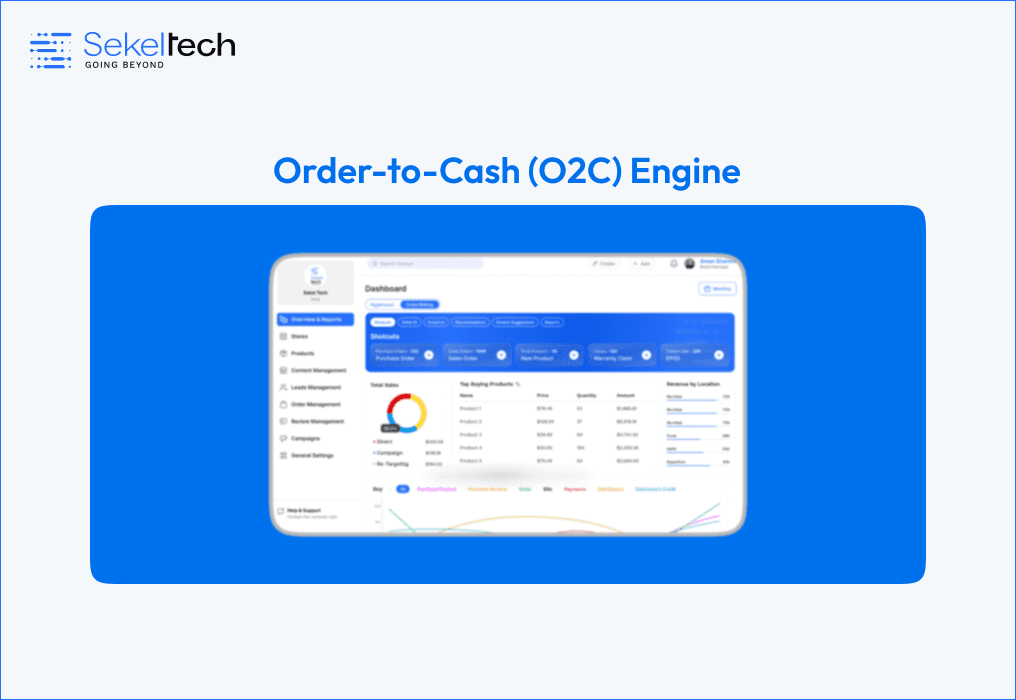
Most O2C platforms were built for centralised operations. Sekel Tech's order-to-cash business process engine was built for multi-location retail brands managing stores, dealers, distributors, and dark stores across complex distribution networks.
Sekel Tech's O2C Engine unifies the complete transaction lifecycle across all channels in one closed-loop system. Billing, compliance, fulfillment, payment processing, warranty management, and smart delivery routing all operate within one platform without manual handoffs between systems.
Feature | What It Does |
| Unified Omnichannel Ordering | EPOS, BOPIS, Ship-from-Store, and returns in one system |
| Instant Invoicing and Billing | Automated, compliance-ready invoicing at every transaction |
| Payment Gateway | Integrated payment processing and A2A payment management |
| Inventory Management | Real-time SKU level tracking across all locations |
| Delivery Management | Smart routing for fast and accurate fulfillment |
| Warranty and Service Management | Automated claims, scheduling, and NPS tracking |
| Sekel Agentic AI | Autonomous decisions across the entire O2C cycle |
Brands on Sekel Tech achieve 80% faster order to cash cycles, 18-20% search to store visit conversion, 75% improvement in field productivity, and 40-50% year-over-year revenue growth.
Who Should Use an O2C Platform
A modern order to cash business process platform benefits any business that moves products through a supply chain, manages multiple payment channels, or operates across more than one location.
Industry | Primary O2C Benefit |
| Fashion and Apparel | Real-time inventory across sizes and colours, unified customer profiles |
| Consumer Electronics | Accurate order fulfillment, warranty tracking, multi-location service |
| Beauty and Personal Care | Personalised recommendations, loyalty programme integration |
| Home and Furnishing | Large inventory management, delivery coordination |
| Automotive | Dealer network optimisation, parts inventory control |
| Food and FMCG | Fast inventory turnover, expiry management |
| Healthcare and Pharmacy | Compliance tracking, prescription management |
| Banking and Finance | Multi-branch reconciliation, commission automation |
| Jewelry | High-value inventory tracking, COD management |
| Retail and Department Stores | Omnichannel order management, unified customer data |
If your business is processing orders manually, reconciling payments across disconnected tools, or struggling to maintain visibility across locations, an integrated order to cash (O2C) platform is the next logical step. The question is not whether you need one. It's how much the current gaps are already costing you.
Watch how Sekel Tech helps retail brands boost local search rankings, drive foot traffic, and convert leads into sales.
Frequently Asked Questions (FAQs)
1. What is the difference between O2C and P2P?
Order-to-cash manages revenue coming in, from customer order to payment collection. Procure-to-pay manages spend going out, from procurement to vendor payment. Both benefit from automation but serve opposite ends of the cash flow cycle.
2. What is a cash application in O2C?
Cash application is the process of matching incoming payments to their corresponding invoices. It is one of the final steps in the order to cash business process and is critical for accurate reconciliation and real-time visibility into outstanding balances.
3. What is days sales outstanding in O2C?
Days sales outstanding measures how long it takes a business to collect payment after a sale. A lower DSO means faster cash collection. Automating the order to cash (O2C) process consistently reduces DSO by eliminating invoicing delays and manual payment tracking.
4. How does O2C affect customer experience?
Every customer-facing step, order confirmation, delivery updates, accurate invoicing, and smooth returns, is part of the O2C process. When it runs well customers notice. When it breaks down they notice even more.
5. Can the order-to-cash process be fully automated?
Yes. Modern O2C platforms automate order capture, credit checks, invoicing, payment reconciliation, and reporting end to end. Sekel Tech's Agentic AI goes further by making autonomous decisions across the entire order to cash business process without manual intervention.
Conclusion
Understanding what is order to cash process is the first step. Building one that actually works at scale is the real challenge. The order to cash process steps, from order management and credit checks through fulfillment, invoicing, payment collections, and reporting, are not just operational checkboxes. They are the backbone of how a business converts sales into cash, maintains customer trust, and scales without losing control. Every breakdown in the o2c process costs revenue somewhere. Every improvement compounds into faster cash flow, lower operational costs, and better customer experiences. For multi-location retail brands managing complex distribution networks, a unified order to cash business process platform is no longer optional. It is the foundation everything else is built on. Explore Sekel Tech's Order-to-Cash Platform